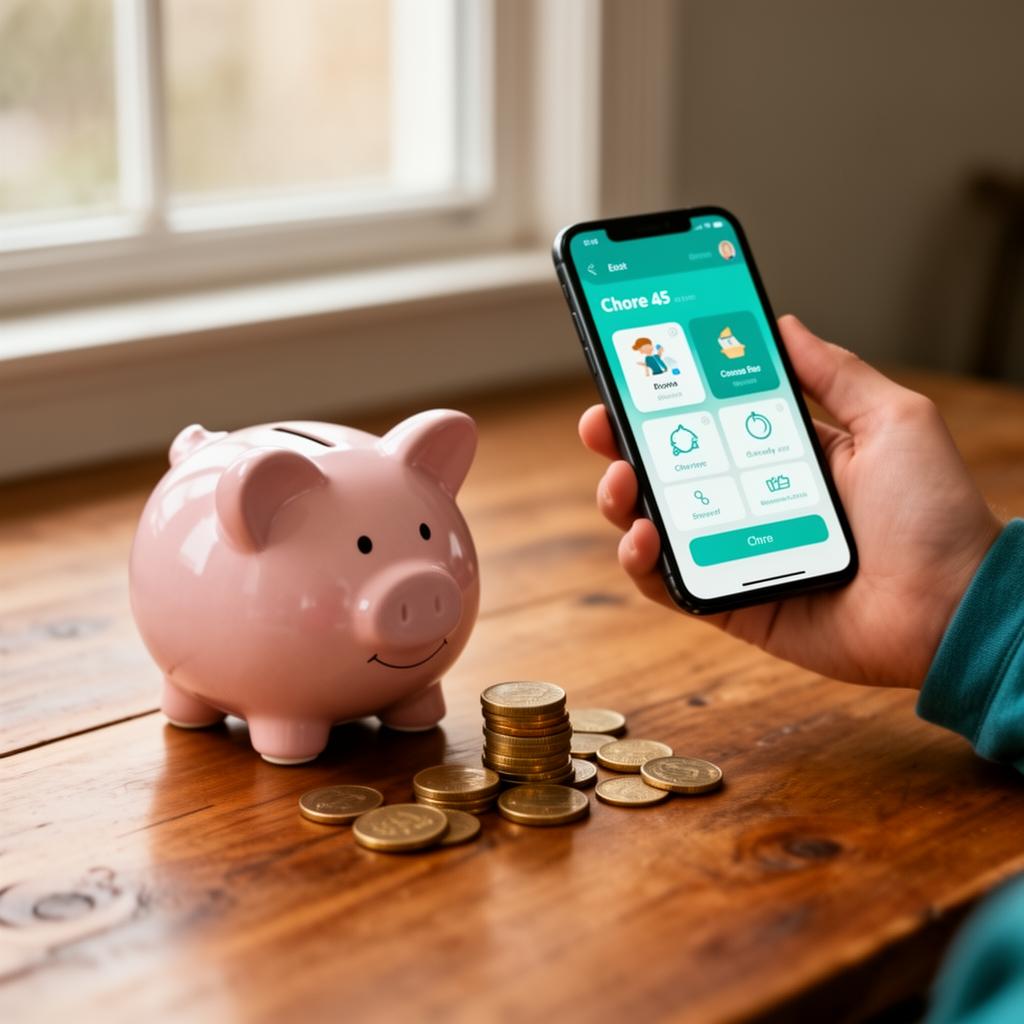

There are two big philosophies in family motivation, and most parents stumble into one without ever choosing between them.
Money-based rewards say: do this thing, get paid. The currency is real cash, the reward is individual, and the loop is transactional.
Habit-based rewards say: do this thing because it''s how we live, and over time the family celebrates together. The currency is internal (tokens, points, stickers), the reward is shared, and the loop is relational.
Both can work. But they don''t produce the same kid.
What money-based rewards actually teach
Apps like Greenlight, GoHenry, and BusyKid are excellent at building money skills — saving, budgeting, the difference between needs and wants. For a 10-year-old who''s ready for that, they''re a great tool.
What they don''t teach is the habit underneath the chore. A child who only takes the bin out when there''s a dollar attached learns "bins = money." A child who takes the bin out because it''s their part of the family rhythm learns something different: this is what we do.
The difference shows up around age 14, when the dollar stops being motivating and you suddenly need the habit to carry on without it.
What habit-based rewards actually teach
In a habit-based system, the reward isn''t the point — it''s the proof. Tokens, stars, points, whatever the unit is, they''re a marker that something happened. The actual reward comes later, and it''s usually shared: a family movie, a trip to the park, a special meal, choosing the weekend activity.
This matters because it weaves the daily effort into the relational fabric of the family. The child isn''t earning their reward — they''re contributing to our celebration. That''s a very different psychological frame, and it''s the one that tends to outlast the novelty period.
What about consequences?
This is where the two systems diverge most sharply. In a money-based system, the natural consequence for doing badly is "you don''t get paid." Some apps even let you fine kids — taking money back for missed chores or rule-breaking.
That''s a fast way to break trust. The child learns that the system can punish them financially, which makes the whole arrangement feel adversarial rather than supportive.
The habit-based equivalent — the one we use in famio — is what we call a Good Habit Card: a small, age-appropriate productive task that closes the loop after a rule is broken. Not a punishment, not a lost reward, just a way to repair and move on. Tokens are never deducted as punishment. That''s a deliberate design choice, not an oversight.
How to choose
If your goal is financial literacy and your kids are old enough, money-based works. If your goal is daily structure, parental alignment, or behavior shaping, habit-based is the better tool. Many families end up using both, for different jobs.
We wrote two side-by-side comparisons that go deeper into this:
- famio vs. allowance apps — for the money-rewards crowd
- famio vs. chore chart apps — for the task-tracker crowd